
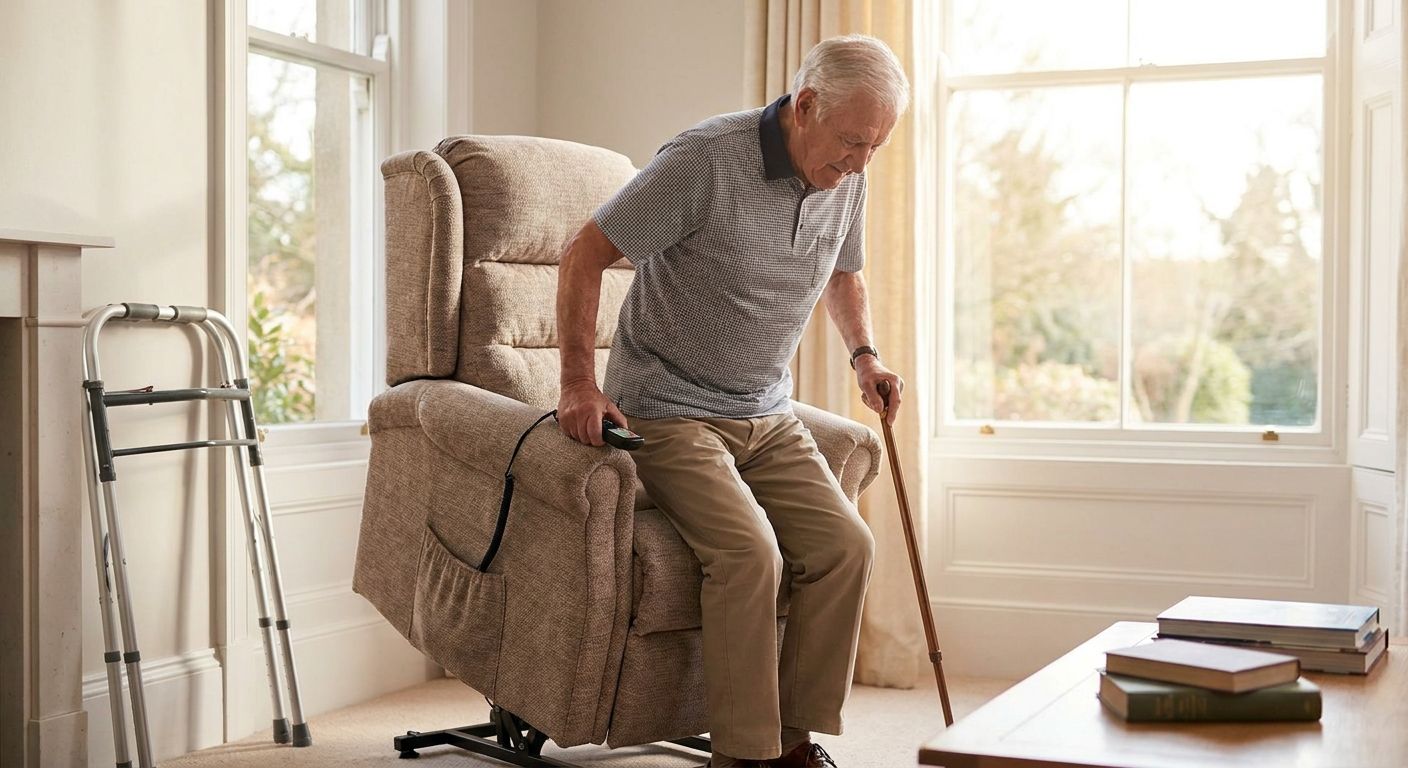
A lift chair for fall prevention has to do two jobs at once: help someone sit and stand without stress on the knees, and never introduce a new stumble in the process. This guide breaks down what actually reduces fall risk in a lift chair and which models on Edward Creation earn a genuine buy for 2026.
- A lift chair for fall prevention needs battery back-up, a wide stable base, and a controlled recline speed for 2026 buyers.
- The StashEase Oversized Lift Chair with Battery Back-Up is the safe pick for households worried about power outages.
- The Titan Lift Chair with 500 lb capacity and a 28-inch seat is the stability pick for larger frames.
- Skip plush zero-gravity chairs as a first purchase if balance during the stand-up phase is the main concern.
Why this matters
Most falls involving recliners happen during the transfer, not while seated. A chair that lurches upright too fast, or one with a soft, sinking cushion, forces the user to catch their balance mid-motion, which is exactly the moment a balance disorder makes dangerous. Edward Creation's lift chair collection is built around slow, motor-controlled lift cycles specifically because that transfer moment is where falls start.
By 2026, occupational therapists routinely recommend powered lift chairs over standard recliners for clients with vestibular issues, Parkinson's-related tremor, or post-stroke instability, precisely because the motor removes the guesswork from standing up. The chair does the lifting; the person just has to stay upright while it happens.
Who this is for
This guide is for family caregivers and older adults managing a diagnosed balance disorder, vertigo, peripheral neuropathy, or a recent fall history, who are choosing a lift chair specifically to reduce the risk of another fall at home. It's also relevant if the household has already had a near-miss getting out of a standard recliner or sofa.
What to look for in a lift chair for fall prevention
A wide, low-slung base
A narrow base with a high center of gravity tips more easily when someone leans on the armrest to steady themselves. Look for oversized or big-and-tall frames with a footprint that extends well past the seat width, since that extra base area is what keeps the chair from rocking during an unsteady transfer.
Battery back-up power
A power outage that strands someone mid-recline is a real fall risk, not a minor inconvenience. Chairs with a built-in battery back-up keep the lift and recline motors functional for a limited window even with no wall power, which matters most for anyone who can't safely get up unassisted from a fully reclined position.
Controlled, single-speed lift motion
A jerky or overly fast recline mechanism throws the body's balance system off right when it's most vulnerable. If a lift chair takes more than a second to change recline angles, it's too jerky for someone with balance issues — the motion should feel gradual enough that the user never has to brace against sudden movement.
Seat height matched to the user
A seat that's too low forces a deeper knee bend to stand, which recruits more quad strength and balance control than most people with vestibular issues have available. Standard lift chairs and oversized models sit at different heights, so matching seat height to the individual's leg length reduces the effort needed at the exact moment falls are most likely.
Lay-flat capability for recovery periods
Someone recovering from a fall, a hip issue, or a stroke often needs to change position without a full transfer to a bed. Lay-flat lift chairs with dual motors let a caregiver adjust the recline angle in small increments, which keeps the user supported through every stage of the movement instead of just at the two end positions.
Weight capacity with margin
A chair rated right at someone's body weight has less structural margin during an unsteady, off-center push-up. Extra-wide models rated to 500 lbs give real headroom for anyone who leans hard on one armrest while standing, which is common with one-sided weakness after a stroke.
“If a lift chair takes more than a second to change recline angles, it's too jerky for someone with balance issues.”
Top picks for fall prevention
The safe pick: StashEase Oversized Lift Chair with Battery Back-Up. This model pairs an oversized frame with a built-in battery back-up, so a power outage doesn't strand the user mid-recline — a real scenario for anyone who can't stand unassisted from a reclined position. Buy if uninterrupted power during outages is a household concern, which it should be for most fall-risk households in 2026.
The stability pick: Titan Lift Chair with 500 lb capacity. It carries a 28-inch wide seat, a foot rest extension, and a 500-lb weight rating, which together give a wider, lower base than a standard-width recliner. Buy for larger-frame users or anyone who leans hard on one side of the chair to stand.
The recovery pick: SleepingTitan Origin Lay-Flat Lift Chair. Dual motors let a caregiver walk the recline angle down in small steps instead of one big drop to horizontal, which matters during the first weeks after a fall or a joint procedure. Consider this one specifically for short-term recovery use rather than as an everyday chair.
The wildcard: ZeroG Zero Gravity Lift Chair Recliner. Zero-gravity positioning distributes weight evenly across the frame, which reduces pressure points during long sitting stretches, but the reclined zero-gravity posture isn't the fastest chair to exit from a dead stop. Consider it for comfort between transfers, not as the primary fall-prevention chair.


What to avoid
- Overly soft, deep-cushion recliners marketed as "comfort chairs": the cushion swallows the user, which means more effort and less control during the sit-to-stand transition.
- Any lift chair without battery back-up as a household's only chair: a power outage during a mobility-critical moment turns a comfort feature into a stranding hazard.
- Narrow, standard-width frames for anyone with one-sided weakness: a narrow base combined with an off-center push to stand is a common fall setup after a stroke.
Verdict comparison
| Pick | Best for | Stability feature | Weight capacity | Verdict |
|---|---|---|---|---|
| StashEase Oversized Lift Chair w/ Battery Back-Up | Power outage safety | Built-in battery back-up | Oversized frame | Buy |
| Titan Lift Chair, 500 lb capacity | Larger frames, one-sided push-up | 28-inch wide seat, foot rest extension | 500 lbs | Buy |
| SleepingTitan Origin Lay-Flat | Short-term recovery | Dual motor, 180° incremental recline | Standard | Consider |
| ZeroG Zero Gravity Lift Chair Recliner | Pressure relief between transfers | Even weight distribution | Standard | Consider |
FAQ
What's the best lift chair for fall prevention in 2026?
The StashEase Oversized Lift Chair with Battery Back-Up is the strongest all-around pick for 2026 because it pairs a wide, stable base with power backup during outages. For larger frames, the Titan Lift Chair with its 500 lb capacity and 28-inch seat is the better fit.
Is a lift chair better than a standard recliner for balance disorders?
Yes, a powered lift chair is better than a standard recliner for balance disorders because the motor controls the stand-up transition instead of the user pushing off unassisted. Standard recliners rely entirely on arm and leg strength at the exact moment falls are most likely.
How much does a lift chair for fall prevention cost?
Lift chairs built for fall prevention typically run from the mid-hundreds to just under a thousand dollars depending on frame size, motor count, and battery back-up. Check current pricing on the Edward Creation site since options and configurations change.
Do lift chairs need a battery back-up?
A battery back-up isn't mandatory but is strongly recommended for anyone who can't stand unassisted from a reclined position. Without it, a power outage can leave someone stranded mid-recline until power returns.
What weight capacity should a fall-prevention lift chair have?
Choose a capacity with margin above the user's body weight, since an unsteady or off-center push to stand puts more stress on the frame than a controlled, centered transfer. Models rated to 500 lbs, like the Titan Lift Chair, give that extra headroom.
Are zero-gravity lift chairs good for balance disorders?
Zero-gravity lift chairs are good for pressure relief during long sitting stretches but are not the fastest chairs to exit from a reclined position. They work best as a secondary comfort chair rather than the primary fall-prevention chair.
Can a lift chair help after a stroke?
A lift chair can help after a stroke by controlling the stand-up motion for someone with one-sided weakness, reducing the risk of an off-center fall. Dual-motor lay-flat models also let a caregiver adjust position gradually during recovery.
What's the difference between lay-flat and standard lift chairs?
Lay-flat lift chairs recline in small, motor-controlled increments all the way to horizontal, while standard lift chairs stop at a fixed reclined angle. Lay-flat models suit recovery periods where position needs frequent, gradual adjustment.
One last thing
The detail most households miss: the fall risk in a recliner usually isn't the sitting position, it's the four seconds it takes to go from seated to standing. A lift chair for fall prevention earns its price in those four seconds, not in how it looks in the living room. Match the motor speed and base width to the person, not the room.