
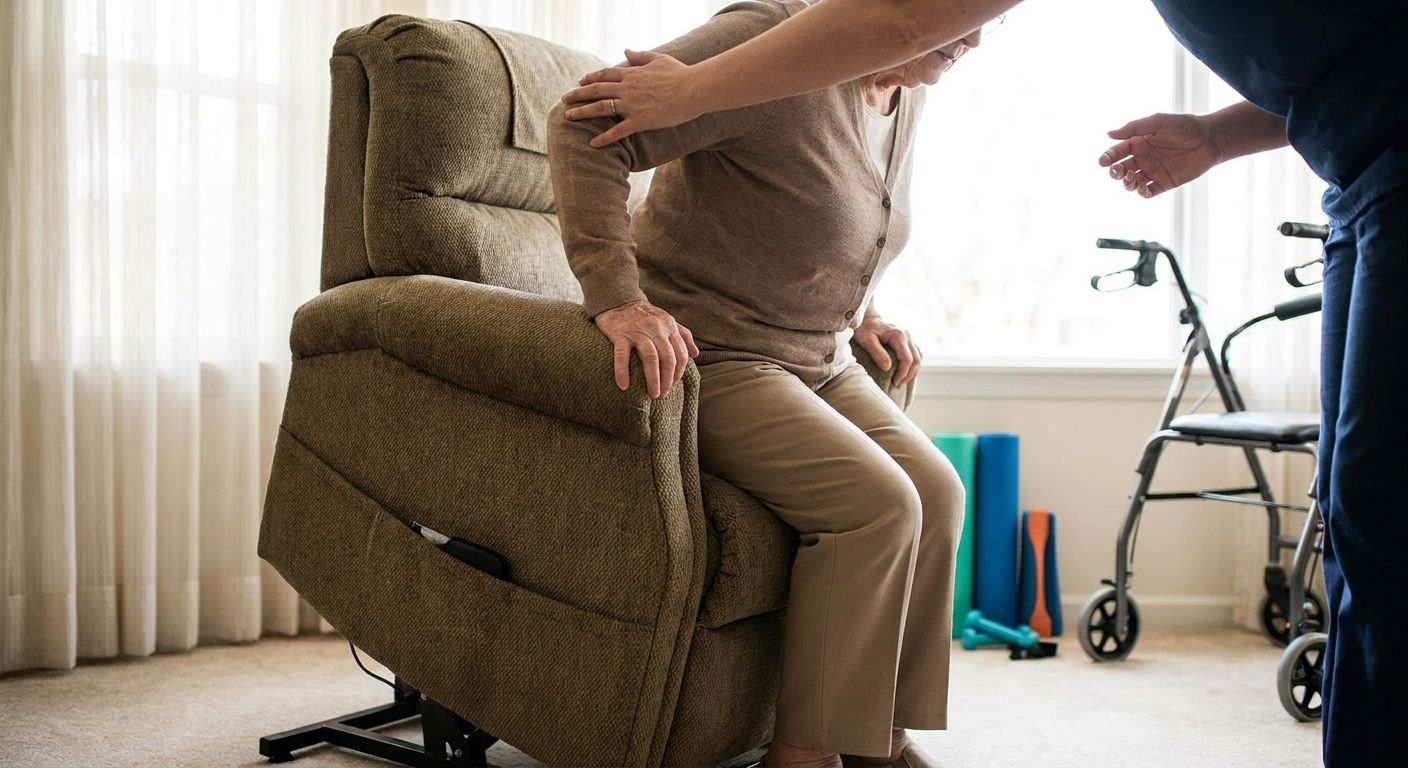
A stroke changes how someone sits, stands, and transfers — and the right lift chair for stroke recovery turns a shaky standing transition into a controlled, one-button motion. This guide breaks down what actually matters for stroke survivors and caregivers shopping for a lift chair in 2026, plus which models from Edward Creation fit and which to skip.
- The best lift chair for stroke recovery in 2026 supports one-handed control and a stable stand-to-sit transfer.
- ZeroG Zero Gravity Lift Chair distributes weight evenly for stroke patients with balance or circulation issues — Buy.
- StashEase Oversized Lift Chair with battery back-up keeps the lift motor working through power outages — Buy.
- Titan Lift Chair's 500 lbs weight capacity and footrest extension fit larger-frame recovery patients — Consider.
- Skip recliners without a powered lift motor if one-sided weakness (hemiparesis) makes standing unassisted risky.
Why this matters
After a stroke, standing up from a normal chair can be the hardest part of the day — one-sided weakness, poor balance, and fatigue make a simple sit-to-stand transfer a fall risk. A powered lift chair removes that risk by mechanically pushing the seat forward and up until the user is nearly standing, so the legs only have to finish the last few inches.
That's a different job than a regular recliner. Regular recliners tilt back; they don't help anyone get up. Edward Creation's lift chair lineup is built around the sit-to-stand problem specifically, which is why this guide treats "recliner" and "lift chair for stroke recovery" as two different shopping categories, not synonyms. Browse the full lift chair collection before narrowing to specific models below.
Who this is for
This guide is for caregivers and stroke survivors furnishing a recovery room at home — someone dealing with hemiparesis, reduced grip strength on one side, or general deconditioning after a hospital stay. It's built for the person choosing between chair models, not for someone who just wants a comfortable recliner. If the buyer needs a chair that assists a stand-to-sit transfer safely, unattended or with minimal caregiver support, the criteria below apply directly.
What to look for in a lift chair for stroke recovery
One-handed control access
A stroke survivor with weakness on one side needs a hand control that works from either hand and sits within easy reach without leaning. A control that falls between the cushions or requires a two-hand grip defeats the purpose of the chair. Test the remote's button size and placement before buying, since fine motor control is often reduced after a stroke.
Battery back-up for the lift motor
A lift chair that only runs on wall power leaves the user stuck mid-recline during an outage — a real problem for anyone who can't push themselves upright unassisted. Battery back-up isn't a luxury feature for this buyer; it's a safety feature. StashEase's battery back-up model exists specifically to solve this failure point.
Seat width and weight capacity
Post-stroke swelling, reduced activity, and medication side effects can shift a person's frame size during recovery. A seat that fit before the stroke may not fit six months later. Chairs like the Titan Lift Chair, built with a 28-inch wide seat and 500 lbs capacity, give more margin than a standard 20-inch lift chair.
Recline range and lay-flat capability
Some stroke survivors need to elevate their legs above heart level for circulation, or sleep in the chair during early recovery when lying flat in bed is difficult. A chair that only reclines partway limits this. Lay-flat models solve the edema and positioning problem that a standard three-position recliner can't.
Zero-gravity positioning for circulation
Zero-gravity positioning lifts the legs and tilts the torso to reduce pressure on the lower back and improve blood flow — a genuinely useful feature for someone spending long hours seated during recovery. This isn't a marketing gimmick for this buyer; it directly addresses the circulation concerns that come with reduced mobility.
Fabric and cleanability
Stroke recovery often involves incontinence products, physical therapy sessions with lotions or ointments, and general extended sitting. Faux leather or bonded leather wipes clean in seconds; fabric upholstery doesn't. This matters more here than in a typical living-room furniture purchase.
Top picks for stroke recovery
The circulation-friendly pick: ZeroG Zero Gravity Lift Chair
The hook here is even weight distribution — the zero-gravity position takes pressure off the lower back and lifts the legs to reduce swelling risk. At $928, it's positioned for buyers who want the circulation benefit specifically, not just a lift assist. Verdict: Buy for stroke survivors managing edema or long seated hours. See the ZeroG Zero Gravity Lift Chair.
The power-outage safe pick: StashEase Oversized Lift Chair with battery back-up
The hook is the battery back-up itself — the lift motor keeps working when the power doesn't. For a stroke survivor who can't stand up unassisted, a dead lift chair during an outage isn't an inconvenience, it's a hazard. Verdict: Buy for anyone living alone or in an area with unreliable power. Check the StashEase Oversized Lift Chair with battery back-up.
The bariatric-frame pick: Titan Lift Chair, 28-inch wide seat, 500 lbs capacity
The hook is sheer capacity — a 28-inch wide seat and 500 lbs weight rating with a footrest extension, built for larger-frame recovery patients that standard 20 to 22-inch lift chairs can't accommodate. Verdict: Consider if seat width or weight capacity has ruled out other chairs on this list. View the Titan Lift Chair, 28-inch wide seat with footrest extension.


What to avoid
- Manual recliners marketed as "lift-assist." A spring-loaded recliner that pushes the seat forward isn't the same as a powered lift chair — if there's no motor, there's no reliable assist for someone with real balance deficits.
- Narrow-seat chairs on a big-and-tall frame. A 20-inch seat looks fine in photos but pinches a wider frame, which shifts weight unevenly during the lift cycle and increases tip risk.
- Chairs with no battery back-up in an unreliable-power area. If the home has ever lost power mid-storm, a wall-only lift chair is a liability for a stroke survivor who can't stand up unassisted.
Comparison table
| Chair | Seat width | Weight capacity | Battery back-up | Zero gravity | Verdict |
|---|---|---|---|---|---|
| ZeroG Zero Gravity Lift Chair | Standard | Not listed | No | Yes | Buy |
| StashEase Oversized Lift Chair (battery back-up) | Oversized | Not listed | Yes | No | Buy |
| Titan Lift Chair, 28-inch wide seat | 28 in | 500 lbs | No | No | Consider |
For most stroke recovery setups, pair the lift chair with a caregiver pager system so a fall or transfer difficulty gets flagged immediately, since the chair alone can't call for help.
FAQ
What is the best lift chair for stroke recovery in 2026?
There's no single best chair — it depends on the survivor's needs. The ZeroG Zero Gravity Lift Chair suits circulation and edema concerns, while the StashEase Oversized Lift Chair with battery back-up suits anyone worried about power outages during a transfer.
Is a zero-gravity lift chair better than a standard lift chair after a stroke?
Zero-gravity positioning helps with circulation and lower-back pressure during long seated hours, which matters more in early recovery. A standard lift chair is sufficient if the main need is just a safe stand-to-sit transfer.
How much does a lift chair for stroke recovery cost?
Prices on Edward Creation's lineup range from around $321 for the Solace Power Lift Recliner up to $928 for the ZeroG Zero Gravity Lift Chair, depending on features like battery back-up, heat, and massage.
Does a lift chair need battery back-up?
Battery back-up matters most for stroke survivors who can't stand up unassisted, since a power outage would otherwise strand them mid-recline. The StashEase Oversized Lift Chair with battery back-up is built for exactly this scenario.
What weight capacity should a lift chair have for a larger-frame patient?
The Titan Lift Chair carries a 500 lbs weight capacity with a 28-inch wide seat, which covers most bariatric and larger-frame needs that a standard 20 to 22-inch chair can't.
Can a lift chair help with one-sided weakness after a stroke?
A powered lift chair reduces the physical demand of standing up, which helps when one-sided weakness (hemiparesis) makes an unassisted transfer risky. The hand control should be tested for one-handed operation before buying.
Is a recliner the same as a lift chair for stroke recovery?
No. A recliner tilts back but doesn't help a user stand up, while a lift chair uses a motor to push the seat forward and upward, assisting the sit-to-stand transfer that many stroke survivors struggle with.
One last thing
The detail most buyers miss: the hand control matters as much as the motor. A stroke survivor with reduced grip or fine motor control on one side needs large, clearly labeled buttons reachable without a two-hand grip — a feature spec sheets rarely mention but caregivers should check before buying in 2026.