
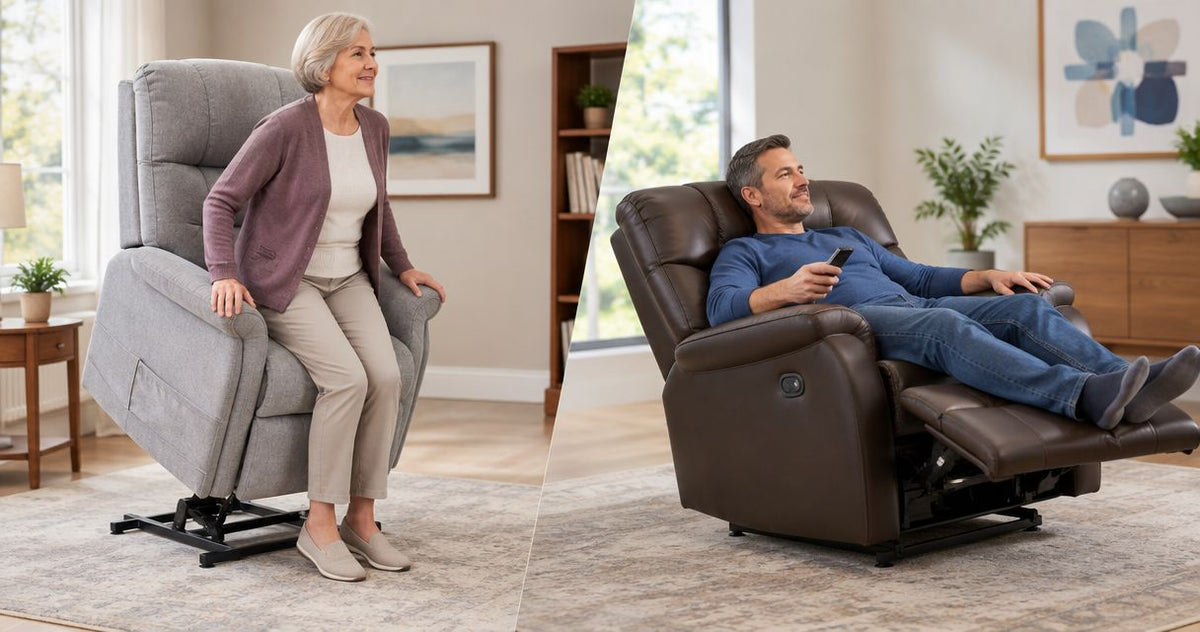
A lift chair uses a motor that tilts the entire chair forward to raise you to near-standing; a power recliner only moves the backrest and footrest and leaves the seat flat on the floor. Choose a lift chair if you or a loved one struggles to stand up unassisted after hip replacement, with arthritis, COPD, or Parkinson's. Choose a power recliner if standing isn't the problem and you just want a deep, comfortable recline for TV, reading, or naps.
- Lift chair vs power recliner comes down to one function: standing assistance. Lift chairs have it, power recliners don't.
- Lift chairs like the Titan Lift Chair reach 500 lbs weight capacity for big-and-tall and bariatric users in 2026.
- Power recliners such as the Luna Swivel Rocker Power Recliner swivel and rock — lift chairs generally can't.
- Both categories offer heat, massage, and deep-recline comfort on select 2026 models.
- Battery back-up during a power outage is a lift-chair feature, not a standard recliner one.
Why this matters
The two categories get lumped together because they look alike in a showroom photo — big, cushioned, motorized. The mechanism underneath is what separates them, and picking wrong means either paying for a lift motor you'll never use or buying a recliner that can't help someone off the seat cushion. The Titan Lift Chair is a useful reference point here: it's built specifically around the lift function, with a 500 lbs capacity and a 28-inch wide seat, and it has nothing in common price-wise or mechanically with a standard recliner.
A power recliner is furniture for comfort. A lift chair is mobility equipment that happens to look like furniture. Both matter in a home in 2026, sometimes for the same person at different stages of recovery.
At a glance
| Dimension | Lift Chair | Power Recliner |
|---|---|---|
| Best for | Standing assistance, limited mobility | Deep recline for relaxation and TV |
| Lift mechanism | Motor tilts entire chair forward | None — recline only |
| Weight capacity | Up to 500 lbs on heavy-duty models | Standard capacity; fewer big-and-tall options |
| Wall clearance | Needs room to tilt forward | Wall-hugger designs need minimal clearance |
| Swivel/rock motion | Rare — chair must sit flush to floor | Common on models like the swivel rocker |
| Recline range | Some models lay flat (180°) | Reclines to a near-flat angle |
| Heat & massage | Available on select models | Available on select models |
| Battery back-up | Available on select models | Not typical |
| Pricing model | Reflects added lift motor, reinforced frame | Reflects recline motor only |
Lift chair wins on standing assistance (by a lot)
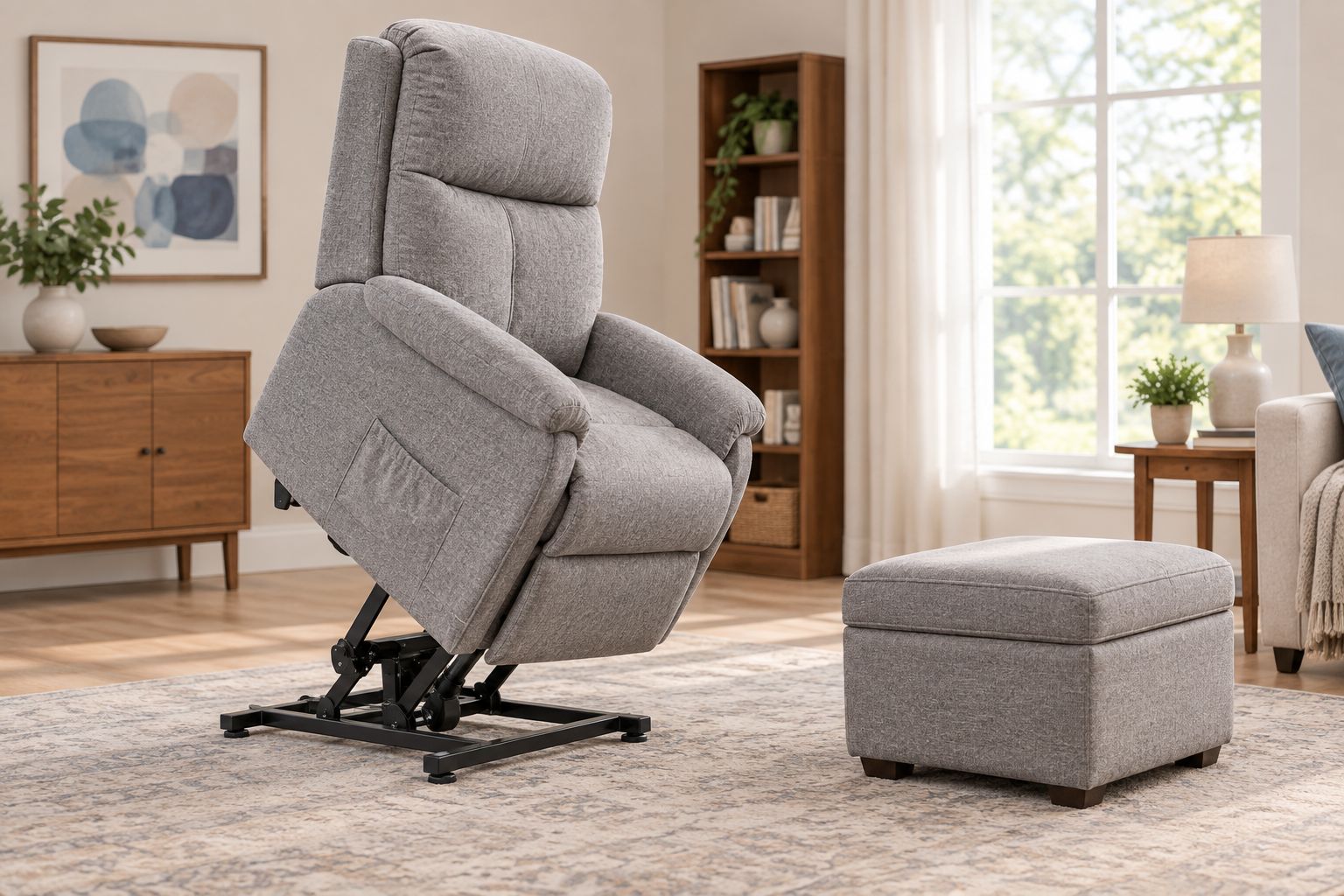
A lift chair is the only one of the two that physically helps you stand. The motorized base tilts the whole seat forward until your feet are under you, cutting the effort of standing from a full leg-and-core push to a light step forward. That's the entire reason the category exists.
Some models add more than one motor to control the back, footrest, and lift independently — the LuxQuad Lift Chair design with four motors is the extreme end of that, letting each section move on its own instead of in one fixed recline arc. A power recliner never needs this because it never has to lift anyone.
Verdict: Lift chair wins. A power recliner cannot replicate this function at any price point.
Lift chair wins on weight capacity for bariatric and big-and-tall users
Heavy-duty lift chairs are built with reinforced frames to carry more weight safely through the lift cycle, not just while seated. The Titan Lift Chair and the GrandNest Lift Chair both target 500 lbs capacity with dual motors, and the StashEase Oversized Lift Chair adds a 28-inch wide seat for users who need more lateral room.
Standard power recliners aren't built around that same reinforcement requirement since they never bear the mechanical stress of a lift cycle. Bariatric-rated recliners exist, but the category isn't engineered around weight capacity the way lift chairs are.
Verdict: Lift chair wins, especially for big-and-tall households.
Power recliner wins on wall clearance in small rooms
A lift chair's tilt-forward motion needs open floor space in front of it — push it against a wall and the lift cycle either stalls or shoves the chair backward. Power recliners, especially wall-hugger models, are built to slide forward on the seat track instead of tilting, which means they can sit within a few inches of the wall.
That difference matters most in apartments, small bedrooms, or anywhere floor space is already tight. If you need to measure your room for a chair like this, the clearance requirement for a lift chair is the number that trips people up most often.
Verdict: Power recliner wins on space efficiency.
Power recliner wins on swivel and rocking motion
Because a lift chair's base has to stay flush to the floor to tilt safely, swivel and rocking motion are almost never built in. Power recliners don't have that constraint — the Luna Swivel Rocker Power Recliner with Heat and Massage combines a full swivel base, a gentle rocking motion, and power recline in one chair, which no lift chair in this comparison offers.
For someone who wants to turn toward a conversation or rock gently while relaxing, that's a real functional gap on the lift chair side.
Verdict: Power recliner wins, no honest way around it.
Both handle recline range and comfort positions well
This is the closest call in the whole comparison. Lay-flat lift chairs like the SleepingTitan Origin reach a 180° near-flat position, which matches or beats what most power recliners offer. Standard power recliners recline to a comfortable near-flat angle too, just without the lift function riding along.
If recline depth alone is the deciding factor, neither category has a clear edge in 2026 — the model you pick matters more than the category.
Verdict: Tie.
Both offer heat and massage on select models
Heat and massage aren't exclusive to either category anymore. Several lift chairs and several power recliners both ship with built-in heat elements and multi-point massage motors as an add-on feature, not a category-defining one.
If heat and massage is a must-have, check the individual product listing rather than assuming the category decides it.
Verdict: Tie.
Pricing: what you're actually paying for
Neither category prices itself the same way, and the difference tracks the mechanism, not the marketing. A lift chair's cost reflects the added lift motor, the reinforced frame needed to carry weight through a tilt cycle, and — on some models — a back-up battery pack that keeps the lift function working during a power outage.
A power recliner's cost reflects a simpler mechanism: one or two motors moving the back and footrest, no lift structure, no reinforced base. That's not a quality difference, it's a function difference — you're paying for what the chair actually does, not for a brand premium on either side. Check current pricing on each product page directly since it changes model to model.


Final verdict
Choose a lift chair if you're a caregiver or family member setting up a home for someone recovering from hip or knee surgery, living with arthritis, COPD, or Parkinson's, or living alone with a real fall risk when standing up. The Titan Lift Chair or a battery-backed model is the right call here.
Choose a power recliner if the person using the chair can stand up fine on their own and just wants a comfortable spot to relax, watch TV, or nap, especially if swivel or rocking motion matters. The Luna Swivel Rocker Power Recliner fits that profile.
A lift chair solves a mobility problem; a power recliner solves a comfort problem — buying the wrong one for the wrong problem wastes money either way.
Scorecard
| Dimension | Winner |
|---|---|
| Standing assistance | Lift chair |
| Weight capacity | Lift chair |
| Wall clearance | Power recliner |
| Swivel/rock motion | Power recliner |
| Recline range | Tie |
| Heat & massage | Tie |
FAQ
What's the difference between a lift chair and a power recliner?
A lift chair has a motor that tilts the whole seat forward to help you stand; a power recliner only moves the backrest and footrest and stays flat on the floor. That standing-assist function is the entire distinction between the two categories in 2026.
Is a lift chair better for elderly parents than a recliner?
If the concern is difficulty standing up unassisted, yes — a lift chair addresses that directly and a recliner does not. If standing isn't an issue, a power recliner covers comfort needs without the added lift mechanism.
Can a power recliner help someone stand up?
No. A power recliner reclines the back and footrest but the seat base stays fixed to the floor, so it offers no lift assistance. Only a lift chair has the motorized tilt function for standing.
Do lift chairs need more space than recliners?
Yes, in most cases — a lift chair needs open floor clearance in front to tilt forward safely, while wall-hugger power recliners can sit within inches of a wall.
How much weight can a lift chair hold?
Heavy-duty lift chairs like the Titan Lift Chair and GrandNest Lift Chair are rated up to 500 lbs. Standard models carry less, so check the listed capacity before buying.
Which is better for arthritis, a lift chair or recliner?
A lift chair is generally the better fit for arthritis because the standing assist reduces joint strain on the way up. A power recliner can still help with seated comfort but won't reduce the effort of standing.
Do lift chairs work during a power outage?
Only models with a back-up battery pack keep the lift function working during an outage — standard lift chairs and standard power recliners both stop working without electricity.
Can you find heat and massage in both lift chairs and recliners?
Yes. Heat and massage are add-on features available on select models in both categories in 2026, not something exclusive to one or the other.
One last thing
The line between the two categories is blurrier than the names suggest: a lay-flat lift chair like the SleepingTitan Origin reaches a 180° near-flat position, which is deeper recline than plenty of standard power recliners manage. If you're shopping by recline depth alone, read the individual product specs — the category name won't tell you which chair actually lays flatter.