
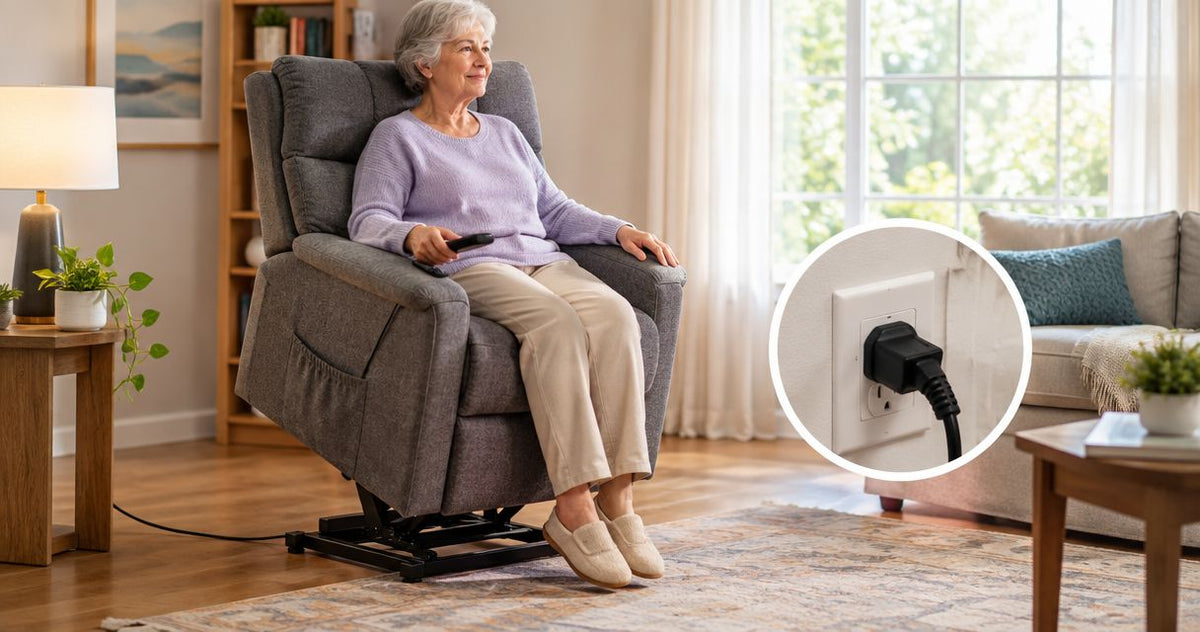
A typical power lift chair draws about 50–100 watts while the motor runs and under 5 watts at rest in 2026. Peak draw during a full lift or recline cycle usually sits near 60–80 watts on single-motor models and can reach 100–150 watts on dual- or multi-motor chairs with heat and massage. The number that matters for your electric bill is the short run time of those motors—not the continuous load of a space heater.
- A lift chair uses about 50–100 watts while motors run, under 5W idle in 2026.
- Full lift/recline cycles last 15–40 seconds, so daily kWh stays low.
- Heat and massage add continuous watts; motors do not.
- Edward Creation lift chairs suit seniors who need safe sit-to-stand help.
Why this matters
Families shopping for a lift chair in 2026 often worry that a motorized recliner will spike the power bill or trip a breaker. The motors only work in short bursts. Heat pads and massage motors are the features that stay on longer. Knowing the watt ranges helps you pick an outlet, size a battery backup, and set realistic expectations before you buy.
How many watts does a lift chair use?
Most residential power lift chairs in 2026 fall into a narrow band:
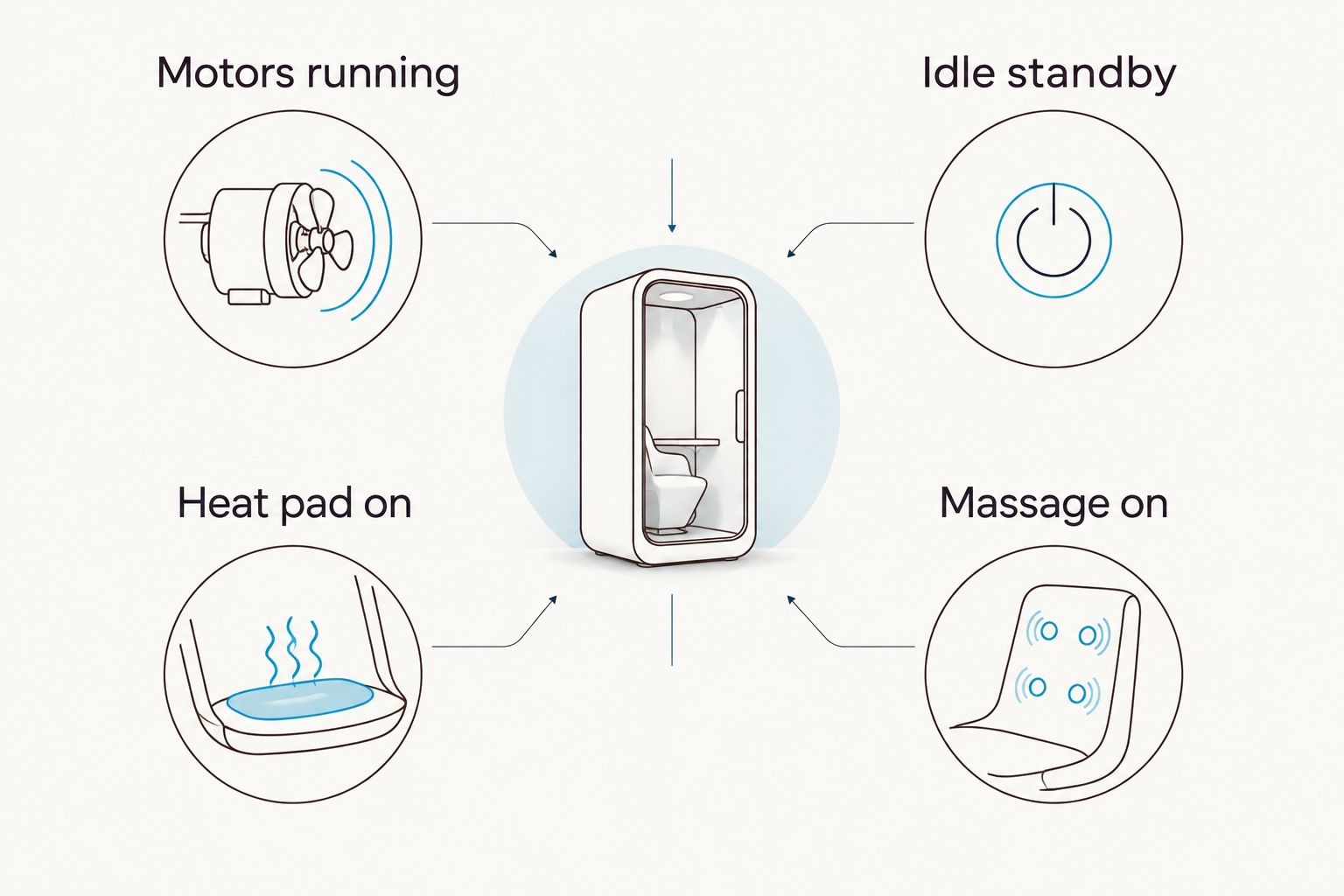
| Mode | Typical watts | What is running |
|---|---|---|
| Idle / standby | Under 5 W | Control board, remote receiver |
| Single-motor lift or recline | 50–80 W | One actuator |
| Dual-motor independent recline | 80–120 W | Back + leg actuators |
| Multi-motor + heat + massage | 100–150 W peak | Actuators plus pads and rollers |
| Heat pad alone (continuous) | 40–80 W | Heating element |
| Massage motors alone | 15–40 W | Vibration or roller units |
A full sit-to-stand or recline-to-flat cycle usually finishes in 15–40 seconds. Even if someone cycles the chair 20 times a day, motor runtime is still only a few minutes. That is why the yearly cost stays modest compared with always-on appliances.
Edward Creation stocks single-motor, dual-motor, and multi-motor lift chairs built for seniors and caregivers who need reliable sit-to-stand help without a heavy electrical footprint.
Single-motor lift chairs: about 50–80 watts while moving
A single-motor chair drives lift and recline on one actuator path. While the motor runs you typically see 50–80 watts. At rest the board draws under 5 watts. These chairs suit users who want a simple remote and one smooth motion from sit to stand. Best for everyday living rooms where power use stays minimal and the outlet is a standard 120V household circuit.
Dual-motor lift chairs: about 80–120 watts while moving
Dual-motor designs let the back and footrest move on separate actuators. Combined draw while both motors work sits around 80–120 watts. Idle remains under 5 watts. Independent leg and back control is the main reason people upgrade. Best for users who need a custom angle for swelling, reflux, or post-surgery positioning without forcing the whole chair into one fixed path. Models such as the SleepingTitan Origin lay flat lift chair fall in this class.
Multi-motor and heat-massage chairs: 100–150 watts peak
Four-motor lay-flat chairs and zero-gravity lift recliners add more actuators plus heat and massage. Peak system draw often lands near 100–150 watts when everything runs at once. Heat pads left on for hours become the larger energy item, not the brief lift cycles. Best for users who want full lay-flat sleep positions, zero-gravity tilt, and built-in heat or massage and who accept a slightly higher continuous load when those comfort features stay on. The ZeroG zero gravity lift chair is one example in this group.


Why lift chair watt use varies
- Motor count. One actuator draws less than two or four running together.
- Heat pads. A pad left on for hours adds 40–80 watts continuously—often more total energy than all daily lift cycles combined.
- Massage motors. Rollers or vibration units add roughly 15–40 watts while active.
- User weight and cycle length. Heavier loads and longer travel distances keep the motor under load slightly longer per cycle.
- Power supply design. Transformers and control boards differ by brand; idle draw stays low across modern chairs but is not identical.
- Battery backup modules. A backup pack adds a small charge-maintenance draw when plugged in; it does not change motor watt ratings.
How much does a lift chair add to the electric bill in 2026?
At a U.S. average near 16 cents per kWh in 2026, a chair that runs motors a few minutes a day and sits idle the rest of the time typically adds well under a dollar a month for motion alone. Leaving heat on for several hours daily is what moves the needle. If you use heat two hours per day at ~60 watts, that is roughly 3.6 kWh per month—still a small line item next to HVAC or a dehumidifier.
Do lift chairs need a dedicated circuit?
No. A standard 120V household outlet on a 15-amp circuit handles a lift chair without a dedicated run in almost every home. Peak draws of 100–150 watts are a fraction of a 15-amp breaker’s capacity. Avoid cheap multi-plug strips that already carry space heaters or window AC units on the same cord.
Will a lift chair work during a power outage?
Only if it has a battery backup. Many Edward Creation models offer backup packs so one or more lift cycles still work when the grid drops. Without a backup, the chair stays in its last position until power returns. If outages are common where you live, choose a chair sold with a backup option or add a compatible pack.
For setup and care details, see how to replace a lift chair battery backup and guides on best lift chairs with battery backup in 2026.
FAQ
How many watts does a lift chair use while lifting?
Most lift chairs use about 50–100 watts while the motor runs in 2026. Dual- and multi-motor models can peak near 100–150 watts for a few seconds.
How many watts does a lift chair use on standby?
Standby draw is typically under 5 watts. The control board and remote receiver stay awake; the lift motor is off.
Does heat and massage raise lift chair power use?
Yes. Heat pads often add 40–80 watts continuously while on, and massage motors add about 15–40 watts. Those features matter more for the bill than short lift cycles.
Is a lift chair expensive to run in 2026?
Motion alone usually costs well under a dollar a month at typical U.S. rates. Continuous heat is the main variable that can raise the total.
Can I plug a lift chair into a regular outlet?
Yes. A standard 120V household outlet on a 15-amp circuit is enough. Peak draw stays far below breaker limits.
Do I need a battery backup for my lift chair?
You need one if you want sit-to-stand help during an outage. Without backup the chair holds its last position until power returns.
How long does a lift chair motor run per use?
A full lift or recline cycle usually lasts 15–40 seconds. Daily motor runtime is measured in minutes, not hours.
Are dual-motor lift chairs higher wattage than single-motor?
Yes while both actuators move—roughly 80–120 watts combined versus about 50–80 watts for a single motor. Idle draw stays similarly low.
One last thing
The feature that quietly uses the most energy is not the lift motor—it is a heat pad left on all afternoon. If your priority is the lowest possible draw, use heat in short sessions and let the motors do the brief, high-value work of getting someone safely on their feet. That pattern keeps 2026 operating cost low while still delivering the mobility help the chair is built for.
When you compare models, match motor count and comfort features to the user, then confirm backup power if outages are a real risk. Edward Creation focuses on lift chairs, recliners, and mobility equipment sized for seniors and caregivers who want clear answers before they order.