
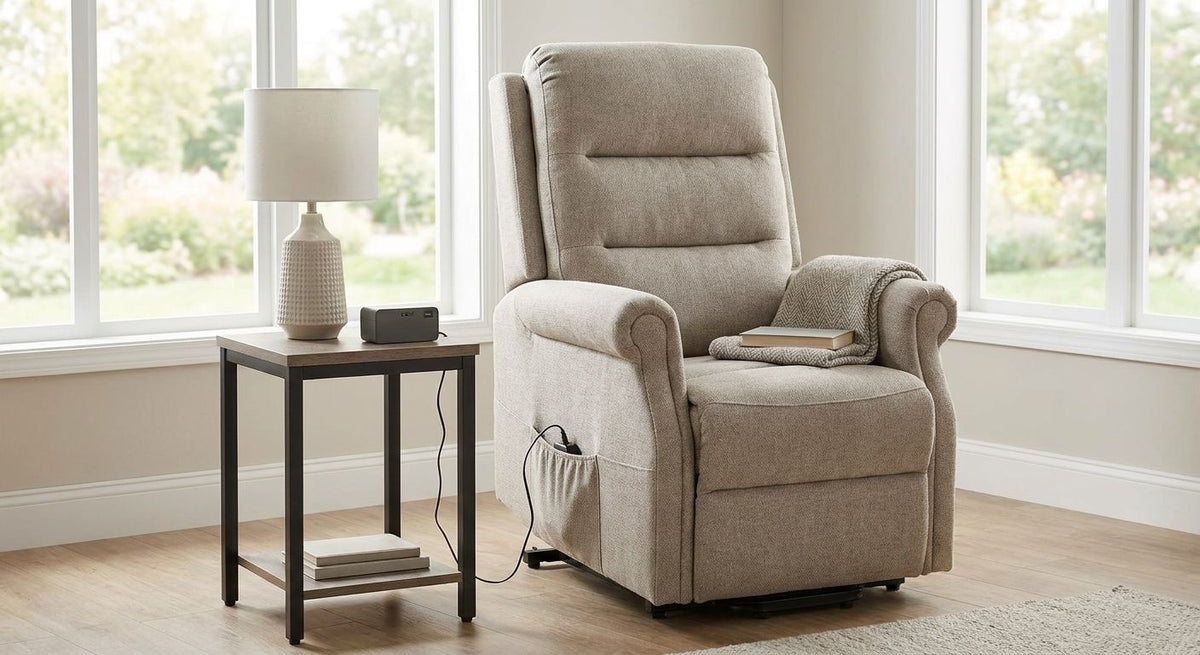
Battery backup on a lift chair means the seat can still lower during a power outage — but not every backup system is built the same, and the right pick depends more on your medical need than on the chair's price tag. This guide ranks six categories of lift chairs with battery backup by use case, so you land on the one that matches your recovery, mobility, or comfort requirement instead of guessing.
- Standard power lift recliners with battery backup are the safest default pick for most homes in 2026.
- Lift chairs with battery backup for COPD patients need a backup system that holds the upright breathing position, not just the down cycle.
- Knee replacement recovery calls for a lift chair with battery backup that locks at a controlled, low-angle stand height.
- Zero gravity lift chairs with battery backup trade lift speed for full-body pressure distribution.
- A backup system that can't complete one full lift cycle on stored power is the wrong system for a home with unreliable electricity.
Why this matters
A lift chair's motor runs on standard household current. When the power goes out mid-cycle, a chair without a backup battery leaves the occupant stuck in a reclined or half-raised position until the electricity returns. Power lift recliners built with a battery backup solve this with a small rechargeable or 9-volt battery wired into the motor control box, giving the chair enough stored charge to finish one lowering cycle.
That single detail matters more for some users than others. Someone recovering from knee surgery needs the chair to lower safely and predictably. Someone with COPD needs the upright assist position to hold steady even if the outlet cuts out mid-breath. The category you should buy from depends on which of those situations describes your household in 2026.
What makes the best lift chair with battery backup
- Backup cycle completion — the battery has to finish a full lift or lower cycle, not just power the remote.
- Motor configuration — dual-motor chairs let the backrest and footrest move independently; single-motor chairs move as one unit.
- Weight capacity match — capacity ratings vary by frame width and steel gauge; undersizing strains the motor and drains backup power faster.
- Upholstery durability — vinyl and performance fabric hold up to daily transfers better than standard polyester in high-use recovery settings.
- Control simplicity — large, clearly labeled buttons matter when a caregiver or a person with limited grip strength is operating the remote.
- Safety certification and lockout — a manual lockout or safety switch keeps the chair from moving during transfers.
At a glance
| Category | Best for | Standout feature | Key limitation |
|---|---|---|---|
| Standard power lift recliners | Overall daily use | Reliable single-cycle battery backup | Limited recline range vs. zero gravity |
| Elderly-focused lift chairs | Daily independence | Wide seat depth, low stand height | Fewer massage/heat options |
| COPD-specific lift chairs | Breathing support | Holds upright assist position on backup power | Narrower recline angles |
| Knee replacement recovery chairs | Post-surgical recovery | Controlled, low-angle stand assist | Not built for extended lay-flat use |
| Zero gravity lift chairs | Full-body pressure relief | Even weight distribution across the frame | Slower lift cycle, higher power draw |
| Lay-flat lift chairs | Caregivers needing a flat surface | Reclines to near-horizontal | Larger footprint, harder to fit small rooms |
1. Standard power lift recliners with battery backup: best overall
Standard power lift recliners cover the widest range of body types and daily needs, which is why they sit at the top of this list for 2026. The battery backup on these models is built for a single job: complete the lowering cycle if the power drops mid-recline. That's the baseline every other category on this list builds on.
Standard power lift recliner pros:
- Widest range of frame sizes and weight capacities
- Simple single- or dual-motor control, easy to learn quickly
- Lower likelihood of a proprietary or hard-to-replace backup battery
Standard power lift recliner cons:
- Recline range is narrower than zero gravity or lay-flat models
- Fewer built-in heat or massage options in base configurations
Best for: anyone without a specific medical condition dictating a narrower category. Verdict: Buy.
2. Lift chairs with battery backup for elderly users: best for daily independence
This category prioritizes low stand-assist height and wider seat depth over recline range or speed. The backup battery matters here because an unassisted stand attempt during a power outage is a fall risk, not just an inconvenience.
Elderly-focused lift chair pros:
- Lower seat height reduces strain on hips and knees during transfers
- Wider armrests give more support during the stand cycle
- Simple remote layouts with large buttons
Elderly-focused lift chair cons:
- Slower lift speed by design, which some users find frustrating
- Base models skip massage and heat features
Best for: aging-in-place households prioritizing safe, repeatable transfers. Verdict: Buy.
3. Lift chairs with battery backup for COPD patients: best for breathing support
COPD changes what "backup power" needs to do. The priority isn't lowering the chair — it's holding the upright, semi-reclined breathing position steady if the outlet cuts out. A lift chair built for COPD patients needs a battery system rated to hold position, not just complete a single motion.
COPD lift chair pros:
- Backup power designed to hold upright assist position, not just lower the seat
- Recline angles calibrated for open-airway breathing positions
- Often paired with firmer back support for posture control
COPD lift chair cons:
- Narrower recline range than general-purpose or zero gravity models
- Higher price sensitivity to backup battery quality means shopping carefully matters
Best for: anyone managing a chronic respiratory condition day to day. Verdict: Buy.
4. Lift chairs with battery backup for knee replacement recovery: best for post-surgical recovery
Knee replacement recovery in 2026 still follows the same physical therapy logic it always has: controlled stand assist at a low angle, minimal twisting, predictable seat height. A lift chair for knee replacement recovery needs battery backup that completes the stand cycle smoothly rather than jerking or stalling partway.
Knee replacement recovery chair pros:
- Controlled, low-angle stand assist reduces joint strain during the lift
- Firm seat cushion supports proper knee alignment during recovery
- Backup battery sized for a full stand cycle, not a partial one
Knee replacement recovery chair cons:
- Not designed for extended lay-flat use during recovery naps
- Recline range is intentionally limited for the first weeks post-surgery
Best for: the first 6-12 weeks after knee surgery, per standard post-op mobility guidance. Verdict: Buy.
5. Zero gravity lift chairs with battery backup: best for full-body pressure relief
Zero gravity positioning distributes body weight evenly across the frame instead of concentrating it at the hips and lower back. The tradeoff is a slower, higher-draw lift cycle, which means the backup battery has to work harder to finish the motion.
Zero gravity lift chair pros:
- Even weight distribution reduces pressure points during long sitting sessions
- Often paired with heat and massage functions
- Recline range extends further than standard power recliners
Zero gravity lift chair cons:
- Slower lift cycle draws more from the backup battery
- Larger frame footprint than standard models
Best for: users managing chronic back pain or circulation issues who spend long stretches seated. Verdict: Buy.
6. Lay-flat lift chairs with battery backup: best for caregivers needing a flat surface
Lay-flat models recline to near-horizontal, which matters for caregivers managing overnight positioning or users who can't tolerate a standard bed angle. The battery backup on these chairs has the longest single cycle to complete of any category here, since it's moving the frame the furthest distance.
Lay-flat lift chair pros:
- Reclines to near-horizontal, useful for overnight or extended rest
- Reduces the need for a separate hospital-style bed in many cases
- Wide range of recline positions between upright and flat
Lay-flat lift chair cons:
- Largest footprint of any category on this list, harder to fit small rooms
- Longest lift cycle means the backup battery needs more stored charge
Best for: caregivers and users who need a flat sleep surface without a hospital bed. Verdict: Hold — confirm room dimensions before buying.
“If the battery backup can't complete one full lift cycle, it's the wrong system for a home with unreliable power.”
How we ranked
Each category above was scored against the six criteria listed earlier: backup cycle completion, motor configuration, weight capacity match, upholstery durability, control simplicity, and safety certification. The ranking order reflects how directly each category solves a distinct use case in 2026 — general use, daily independence, breathing support, post-surgical recovery, pressure relief, and flat positioning — rather than ranking every chair against a single generic standard.
Which lift chair with battery backup should you choose?
For most households in 2026, a standard power lift recliner with battery backup covers the need without over-buying features tied to a specific medical condition. If a diagnosed condition drives the decision — COPD, post-surgical recovery, or a need for full-flat positioning — pick from that category directly instead of defaulting to the general-purpose option. Undecided shoppers should start with the standard category and step up to a condition-specific model only once a physical therapist or physician has specified a positioning requirement.
FAQ
What does battery backup on a lift chair actually do?
It powers a small motor control unit off a stored battery — usually a 9-volt or rechargeable pack — so the chair can complete one lift or lower cycle during a power outage. It does not run the chair indefinitely.
Is battery backup standard on all lift chairs in 2026?
No. Many budget power lift recliners skip battery backup entirely. It's more common on mid-range and higher chairs, and on categories built for medical recovery use.
Do zero gravity lift chairs need a stronger battery backup?
Yes. Zero gravity models have a longer, higher-draw lift cycle than standard recliners, so the backup battery needs more stored charge to finish the motion.
What's the best lift chair with battery backup for COPD?
A COPD-specific lift chair with a backup system rated to hold the upright breathing position, not just lower the seat, works best. Recline angle calibrated for open airways matters more than lift speed here.
How long does a lift chair's backup battery last before it needs replacing?
This varies by manufacturer and battery type, and depends on how often the backup is actually used versus wall power. Check the manual for the specific chair for a replacement interval.
Can a lift chair with battery backup be used during a multi-day power outage?
No. The backup battery is designed for a single lift or lower cycle, not sustained use. It gets the occupant safely out of the chair, then needs wall power or a fresh battery to operate again.
Are lay-flat lift chairs with battery backup harder to power on backup?
Yes, relatively. The lay-flat recline covers more distance than a standard lift cycle, so the backup battery works harder to complete it.
Do I need a dual-motor lift chair for battery backup to work well?
Not necessarily. Single-motor chairs move the backrest and footrest together and often draw less power per cycle, which can be an advantage on backup battery power.
One last thing
The detail most shoppers skip: ask whether the backup battery is a standard, easily replaceable 9-volt or a proprietary rechargeable pack. A standard battery you can buy at any hardware store beats a proprietary one that requires ordering a replacement part and waiting, especially in a household where the chair is a daily mobility tool rather than an occasional-use recliner.