
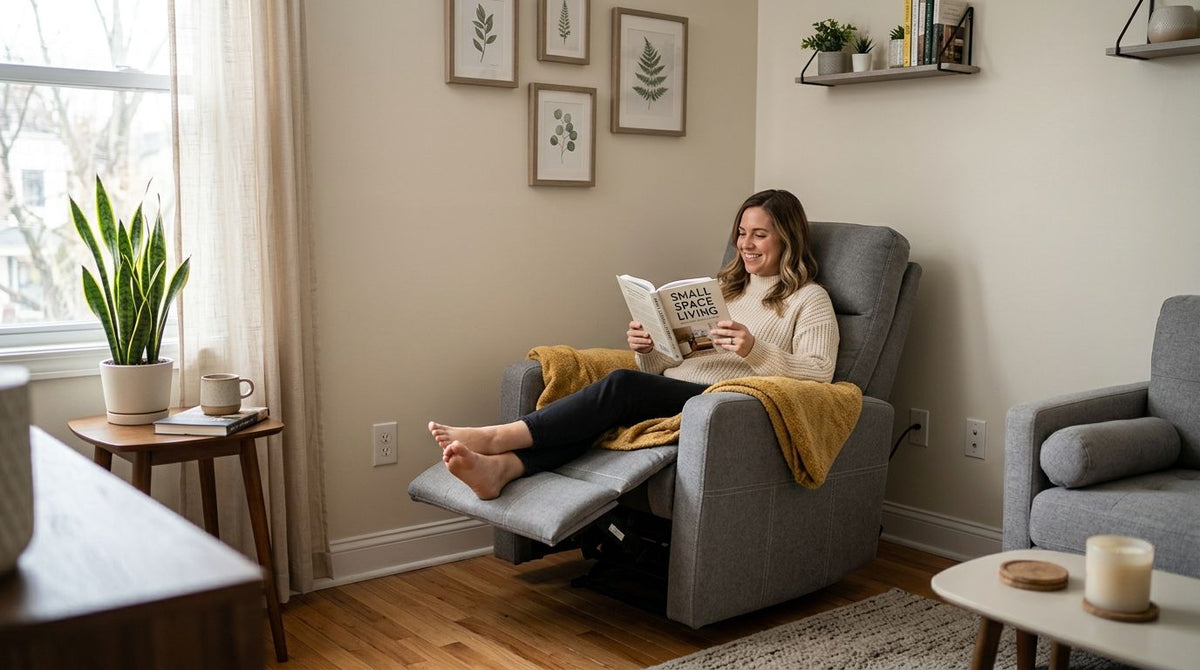
A wall hugger recliner for small apartments is a recliner engineered to fully recline while sitting only 4 to 6 inches from the wall, instead of the 12 to 16 inches a traditional recliner needs to swing its back down. For renters and studio dwellers, that difference decides whether a recliner fits against a shared wall at all or eats a third of the living room just to open.
- A true wall hugger recliner for small apartments needs 4-6 inches of wall clearance, not the 12-16 inches standard recliners require.
- Manual lever models cost less to maintain long-term than power recliners, which need an outlet within reach of the chair.
- Petite and small-frame recliners under 30 inches wide fit studio apartments better than standard 34-36 inch models.
- Measure your doorway and hallway width before ordering — wall huggers still ship in one bulky box.
Why wall hugger recliners matter for small apartment living
Square footage is the constraint that defines apartment furniture shopping, not style. A studio or one-bedroom rarely has the 6 feet of open floor a standard recliner demands when fully reclined, which pushes most apartment dwellers toward compact seating by necessity, not preference.
A wall hugger recliner solves the clearance problem specifically — it doesn't solve width, weight capacity, or upholstery durability, which is why picking one for an apartment takes more than checking "wall hugger" on a product listing. The mechanism only controls how far the chair pulls forward when reclining; everything else about fit still needs measuring.
Renters also face a constraint homeowners don't: many leases restrict wall-mounted anchoring and heavy furniture on load-bearing walls in older buildings. A recliner that doesn't need to be pushed flush against drywall to function reduces both damage risk and the chance of scuffing a security deposit.
How to choose a wall hugger recliner for a small apartment
Measure your wall clearance and floor space
Before comparing models, measure the actual space where the recliner will sit. Most wall hugger recliners need 4 to 6 inches behind the chair to recline fully, but that number varies by mechanism and headrest design, so treat it as a starting range, not a guarantee.
- Measure from the intended wall to the nearest obstruction (door swing, radiator, outlet cover)
- Add 2 inches of buffer beyond the manufacturer's stated clearance for baseboard trim
- Check floor space in front of the chair — reclining shifts the footrest forward, not just the back
- Note ceiling height if the chair has a tall headrest that could hit a sloped ceiling
Check your ceiling height and low-clearance obstacles
Apartments with exposed ductwork, low soffits, or window seats often have less usable vertical space than the square footage suggests. A wall hugger solves horizontal clearance, not vertical.
- Confirm headrest height in the reclined position, not just upright
- Check for window sills or radiator covers directly behind the intended spot
- Rule out sloped ceilings common in attic-converted or top-floor units
- Test clearance with a broom handle or yardstick before the chair arrives
Match the width to your room's footprint
Standard recliners run 34 to 36 inches wide. In a studio or small one-bedroom, that width alone can dominate a room that's only 10 to 12 feet across.
- Look at recliners under 30 inches wide if the room is under 150 square feet
- Check arm width separately — some "compact" recliners keep standard-width arms
- Measure your widest doorway path, not just the room, since delivery crews need clearance too
- Compare footrest depth when extended, not just the chair's resting footprint
Choose a recline mechanism built for tight spaces
Manual lever mechanisms are simpler, cheaper to service, and don't depend on an outlet location. Power mechanisms recline with a button but require the chair to sit within cord length of a plug, which limits placement in apartments with sparse outlets.
- Start with a manual pull-lever model if outlet placement is inconvenient
- Confirm cord length on power models — apartment outlets are often behind furniture, not beside it
- Check if the mechanism has a battery backup option in case of power loss
- Compare power recliners with USB charging if you want charging built into the arm instead of running an extension cord
Pick upholstery that survives apartment wear
Apartments see more foot traffic per square foot than houses — roommates, pets, and guests share less space, which means upholstery takes more contact per year.
- Choose performance fabric or top-grain leather over bonded leather, which cracks faster under heavy use
- Pick darker or patterned upholstery in units with less natural light to hide fading unevenly
- Confirm the fabric is cleanable without professional service if you don't have in-unit laundry access
- Check the seat cushion fill — high-density foam holds shape longer under daily sitting than low-density fill
Furnishing a compact living room means every accessory earns its place the same way the chair does. The same logic that governs modern farmhouse rug sizing applies to scent and finish choices too — in a room with less air volume, materials that off-gas or overpower matter more, which is why non-toxic candles for small spaces get chosen over heavily fragranced ones in studio apartments.
Test the swivel and rocker function before buying
Some wall hugger recliners add swivel or rocking motion. In small apartments, swivel can be more useful than recline distance because it lets one chair face a TV, a window, and a doorway without repositioning furniture.
- Confirm the swivel radius doesn't require pulling the chair away from the wall first
- Check if rocking motion needs floor clearance the wall hugger design doesn't otherwise require
- Compare swivel rocker recliners if flexibility matters more than maximum recline angle
- Test the lock mechanism if the unit has one — apartments with uneven older floors need a stable lock, not just a stiff hinge
Plan the delivery path before you order
Wall hugger recliners still ship as one heavy, boxed unit even though the finished chair is compact. Doorway width, stairwell turns, and elevator dimensions matter more in apartment buildings than in houses.
- Measure your narrowest doorway and stairwell turn, not just the front door
- Confirm elevator interior dimensions if you're above the ground floor
- Ask about return logistics before ordering if the chair doesn't fit through a tight turn
- Check assembly requirements — some models ship fully built, others need the back or arms attached on-site
Comparison: wall hugger recliner types for small apartments
| Option | Best for | Key limitation |
|---|---|---|
| Manual wall hugger recliner | Renters without convenient outlet access | No powered recline or massage function |
| Power wall hugger recliner | Apartments with an outlet near the seating wall | Needs cord management; less mobile once placed |
| Swivel wall hugger recliner | Studios where one chair faces multiple zones | Swivel base adds width some tight corners can't fit |
| Petite/small-frame recliner | Small-frame adults in sub-150 sq ft rooms | Limited weight capacity compared to standard models |
| Rocker-recliner combo | Apartments used for both TV watching and nursing/reading | Rocking motion needs a few extra inches of floor clearance |
Verdict: a manual wall hugger recliner under 30 inches wide is the safest first pick for a studio or one-bedroom apartment in 2026 — it skips the outlet dependency of power models and the width penalty of standard recliners.
Common mistakes apartment shoppers make with wall hugger recliners
- Measuring the chair's footprint but not the delivery path — a recliner that fits the room can still fail to make it through a stairwell turn or elevator door
- Assuming "wall hugger" means zero clearance — nearly every model still needs 4 to 6 inches, not zero, to clear the mechanism housing
- Ignoring outlet placement before buying a power recliner — cords running across a small apartment floor become a trip hazard fast
- Buying standard width because it looked fine in a showroom — showrooms are larger than most apartment living rooms, and 34 inches reads very differently in a 10-foot-wide room
- Skipping the swivel test — a chair that can't pivot toward a window or doorway loses a lot of its value in a studio layout
“If a recliner needs more than 6 inches of wall clearance to fully recline, it isn't a true wall hugger.”
FAQ
What's the best wall hugger recliner for small apartments in 2026?
A manual wall hugger recliner under 30 inches wide with 4-6 inches of stated wall clearance fits most studios and one-bedrooms best in 2026. Power models work too, but only if an outlet sits within cord reach of the seating wall.
How much wall clearance does a wall hugger recliner actually need?
Most wall hugger recliners need 4 to 6 inches of clearance to fully recline, compared to 12 to 16 inches for a standard recliner. Add 2 inches of buffer for baseboard trim before finalizing placement.
Is a wall hugger recliner better than a standard recliner for apartments?
Yes, for space-constrained apartments a wall hugger recliner is better because it solves the clearance problem a standard recliner can't. It doesn't automatically solve width or weight capacity, so those still need separate checking.
Do wall hugger recliners come in narrow or petite sizes?
Yes, petite and small-frame wall hugger recliners under 30 inches wide exist and fit sub-150 square foot rooms better than the standard 34 to 36 inch width. Weight capacity on these models is typically lower than standard-size chairs.
Can a wall hugger recliner swivel or rock?
Some wall hugger models add swivel or rocking motion, which is useful in studios where one chair needs to face a TV, window, or doorway. Confirm the swivel radius doesn't require pulling the chair away from the wall first.
Do power wall hugger recliners work in apartments without nearby outlets?
Power recliners need an outlet within cord length of the chair, which limits placement in apartments with sparse wiring. A manual lever model removes that constraint entirely.
Will a wall hugger recliner fit through a narrow apartment doorway?
Most wall hugger recliners ship boxed and need the same doorway clearance as any recliner regardless of the finished chair's compact footprint. Measure your narrowest doorway and stairwell turn before ordering, not just the room dimensions.
One last thing
The clearance spec on the box only covers the recline function — it says nothing about swivel radius, footrest extension depth, or headrest height when tilted back, and those three numbers are usually what actually determines fit in a small apartment, not the wall gap alone.