
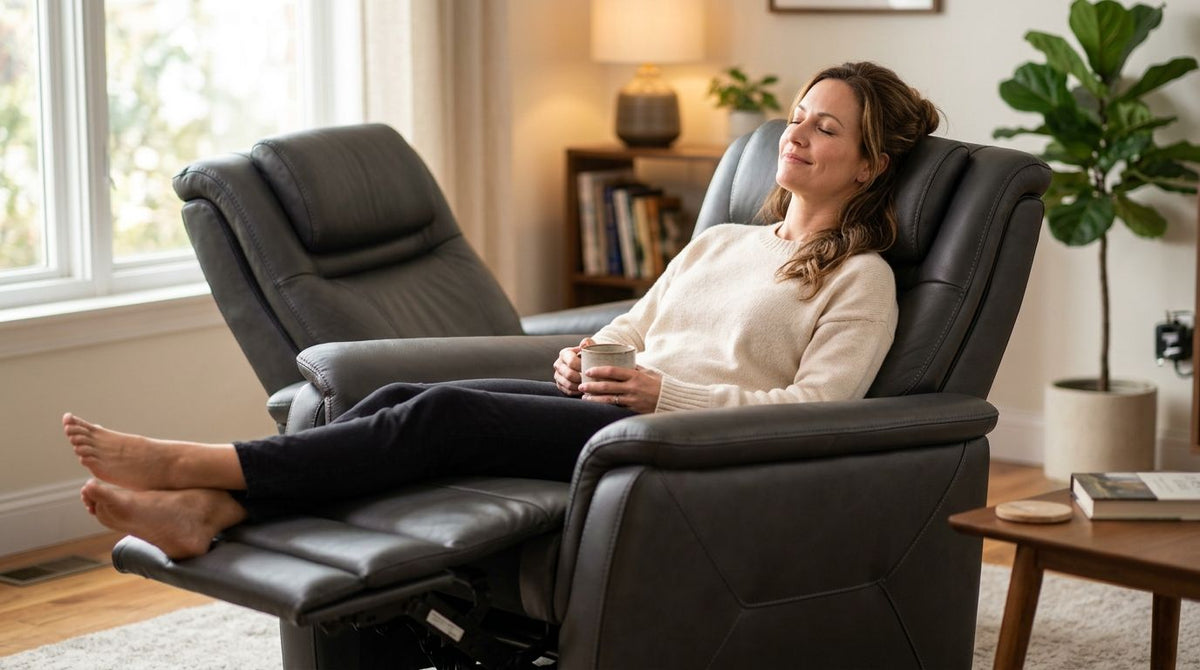
A recliner with an adjustable headrest for neck support is a reclining chair whose headrest tilts, slides, or motors on its own axis instead of moving in lockstep with the backrest. That independent motion is the entire point: cervical spondylosis, tech neck, whiplash recovery, and general neck stiffness all respond differently to head angle than they do to overall recline depth.
- A recliner with adjustable headrest separates neck angle from backrest recline instead of moving both together.
- LuxQuad's 4-motor design controls headrest, lumbar, lift, and recline as four independent points.
- CloudFloat's 139-degree zero gravity position takes load off the cervical spine without a powered headrest.
- Manual ratchet headrests cost less but can't be repositioned once you're already reclined.
- Oversized lift chairs rated to 500 lbs hold headrest position longer under daily use than lighter frames.
Why headrest adjustment matters for neck support
Most recliners bundle the headrest into the backrest motion, so when you recline, your neck tips backward at whatever angle the chair decides. That's fine if you have no neck complaints. It's a problem if you're managing cervical spondylosis, forward-head posture from years at a screen, or stiffness that flares when your chin drops too far back.
A chair like the Nimbus zero gravity power recliner moves the headrest on its own motor, so you can drop the backrest into a deep recline while keeping your neck closer to neutral. That distinction is the difference between a recliner that happens to have a headrest and a recliner with adjustable headrest built specifically for neck support.
Seniors napping upright in a living room chair, caregivers setting up a chair for someone recovering from a cervical fusion, and anyone who spends hours reading or watching TV reclined all need the same thing in 2026: a headrest that moves without dragging the rest of the chair with it.
How to choose a recliner with adjustable headrest for neck support
Check whether the headrest moves independently or with the backrest
Before anything else, find out if the headrest has its own motor or hinge, or if it's fixed to the backrest frame. This single fact determines whether you get real neck support or just a taller cushion.
- Ask whether the headrest has a separate remote button or lever
- Sit in the chair fully reclined and try adjusting the head angle without changing the backrest
- Check if the headrest wings tilt forward, not just up and down
- Confirm the adjustment holds position without sliding back under head weight
- Look for multi-motor language in the product description, not just "adjustable"
Measure your neck-to-shoulder height before you buy
A headrest set for someone 5'4" sits wrong for someone 6'1". Get a rough measurement from your shoulder line to the top of your head while seated, then compare it to the chair's headrest travel range if it's listed.
- Measure seated shoulder-to-crown height at home, not standing
- Note if you usually wear your hair up or down, since that shifts the fit
- Check whether the headrest wings are fixed width or adjustable
- Compare seat depth too, since a too-deep seat pushes your neck further from the headrest
- Re-measure if buying for someone recovering from surgery, since posture often changes during recovery
Test the recline range for a neutral spine angle
Neutral spine, not maximum recline, is the goal for most neck issues. A chair that only offers upright or near-flat with nothing in between forces you into whatever angle happens to land, which can aggravate rather than relieve tension.
- Try the chair at three or four stopping points, not just fully upright and fully flat
- Watch where your chin sits relative to your chest at each stop
- Note whether the recline motion is smooth or jerky, since jerky motion jolts the neck
- Ask if the chair has infinite-position stops versus fixed presets
- Sit for at least five minutes before judging comfort
Match motor count to how much control you actually need
More motors mean more independent adjustment, and also more parts that can eventually need service. A LuxQuad 4-motor lift chair controls headrest, lumbar, lift, and recline separately, which matters if you need to fine-tune neck angle without disturbing lumbar support.
- Single motor: recline only, headrest fixed
- Dual motor: separate control of backrest and footrest, headrest usually still fixed
- Triple motor: adds independent headrest or lumbar control
- Quad motor: headrest, lumbar, lift, and recline all move independently
- Match the motor count to your actual daily use, not the highest number available
Add heat and massage if muscle tension is the root cause
If the neck pain is muscular rather than structural, localized heat and massage at the neck and shoulder area can matter as much as headrest angle. This is a daily-comfort layer, not a substitute for medical treatment.
- Look for heat zones that reach the upper back, not just the lumbar area
- Check if massage intensity has multiple settings
- Confirm heat and massage can run independently of the recline position
- Ask whether the remote has large, simple buttons if arthritis affects grip
- Consider whether a caregiver will need to operate the controls too
Confirm the frame handles daily use without headrest sag
A headrest that adjusts perfectly on day one but sags within a year isn't solving anything. Oversized lift chairs built for higher weight capacities, some rated to 500 lbs, generally use heavier-gauge frames that hold headrest position longer under repeated daily use.
- Check the chair's stated weight capacity against the heaviest regular user
- Ask about the headrest locking mechanism, not just the motor
- Favor chairs with metal internal frames over all-wood construction for daily recline use
- Check reinforcement at the neck and shoulder area specifically
- Plan for multiple recline cycles per day, not occasional use
Plan the recliner's footprint against your wall space
A wall hugger design, like the one on the Nimbus recliner above, slides forward as it reclines instead of requiring space behind the chair. That matters more in small rooms and apartments.
- Measure from your intended wall to the nearest furniture or doorway
- Check the clearance requirement for full recline, not just for sitting
- Consider wall hugger models if the chair sits against a wall
- Leave extra clearance if a caregiver stands beside the chair during transfers
- Recheck clearance if you're adding a side table or other equipment nearby
Comparing recliner types for neck support
| Option | Best for | Key limitation |
|---|---|---|
| Manual ratchet headrest recliner | Budget shoppers who want basic pillow-tilt support | Can't reposition the headrest once you're already reclined |
| Single-motor power recliner, fixed headrest | People who mainly want backrest support, not neck isolation | Headrest still moves with the backrest, no independent angle |
| Multi-motor recliner with independent power headrest (LuxQuad) | Cervical spondylosis, tech neck, anyone needing a precise neck angle | Heavier chair with more motors that can eventually need service |
| Zero gravity recliner (CloudFloat, Nimbus) | People whose neck pain eases lying near-flat with legs elevated | The zero gravity angle doesn't replace headrest tilt for upright sitting |
Verdict: a multi-motor recliner with an independently adjustable headrest is the only option built for neck-specific control, and it's worth the extra cost in 2026 if neck pain, not general fatigue, is the problem you're solving.


Common mistakes people make buying a recliner with adjustable headrest
- Buying on overall chair size alone. A chair can be the right width and still have a headrest wing angle that doesn't match your neck.
- Assuming zero gravity recline fixes every neck problem. Some cervical conditions respond better to a more upright angle than a near-flat zero gravity position.
- Choosing a chair where the headrest and backrest share one motor. That setup markets itself as "adjustable" but delivers no independent neck control.
- Skipping the seated test. A headrest that looks right in a photo can sit two inches too high or low once you're actually seated at home.
- Ignoring weight capacity. A frame rated below the heaviest regular user sags at the headrest joint faster than a heavy-duty frame rated to 500 lbs.
The lift chairs for spinal stenosis and lower back pain guide covers how spine and neck alignment interact in a reclined position, worth reading if lower back pain is part of the picture too.
FAQ
What's the best recliner with an adjustable headrest for neck support in 2026?
A multi-motor recliner like the LuxQuad, which controls headrest, lumbar, lift and recline independently, gives the most precise neck-angle adjustment Edward Creation carries in 2026. Single-motor recliners with fixed headrests can't match that level of control.
Is a power headrest better than a manual ratchet headrest for neck pain?
Power headrests let you reposition your neck angle while already reclined, which a manual ratchet headrest can't do without sitting up first. For anyone with limited grip strength or arthritis, power adjustment is the practical choice.
Do zero gravity recliners help with neck pain?
Zero gravity recliners like the CloudFloat, reclined to 139 degrees, distribute body weight evenly and reduce overall spinal load, which can ease neck tension tied to posture. They don't replace an independently adjustable headrest if you need a specific neck angle while sitting more upright.
How much recline angle do I need for neck support?
Most people managing neck pain do better at a neutral spine angle somewhere between upright and full recline, not at the maximum angle a chair offers. Test a chair at several stopping points rather than judging it only at full recline.
Can a recliner headrest be too high or too low?
Yes. A headrest set above or below your seated shoulder-to-crown height forces your neck into an unnatural tilt, which can worsen stiffness over time. Measuring before you buy avoids that mismatch.
Are 4-motor lift chairs worth it for neck and back support?
A 4-motor lift chair is worth the added cost if you need headrest, lumbar, lift and recline to move independently, which is common with cervical spondylosis or combined neck-and-back conditions. If you only need general recline comfort, a dual-motor chair usually covers it.
How do I know if a recliner's headrest moves independently?
Check the remote for a dedicated headrest button separate from the recline control, and confirm the chair has more than one motor. Adjusting the headrest while already reclined is the most reliable in-person test.
What weight capacity should I look for in a heavy-duty recliner with headrest support?
Oversized lift chairs rated up to 500 lbs generally use heavier internal frames that keep the headrest mechanism stable under daily use. Match the rated capacity to the heaviest regular user to prevent premature sag at the headrest joint.
One last thing
Most recliners marketed as having an "adjustable headrest" in 2026 still tie that headrest to the backrest motor, so the two move together no matter what the listing implies. Motor count is the real dividing line: a quad-motor chair separates headrest, lumbar, lift and recline into four independent controls, and that remains uncommon even at the premium end of the recliner market this year.