
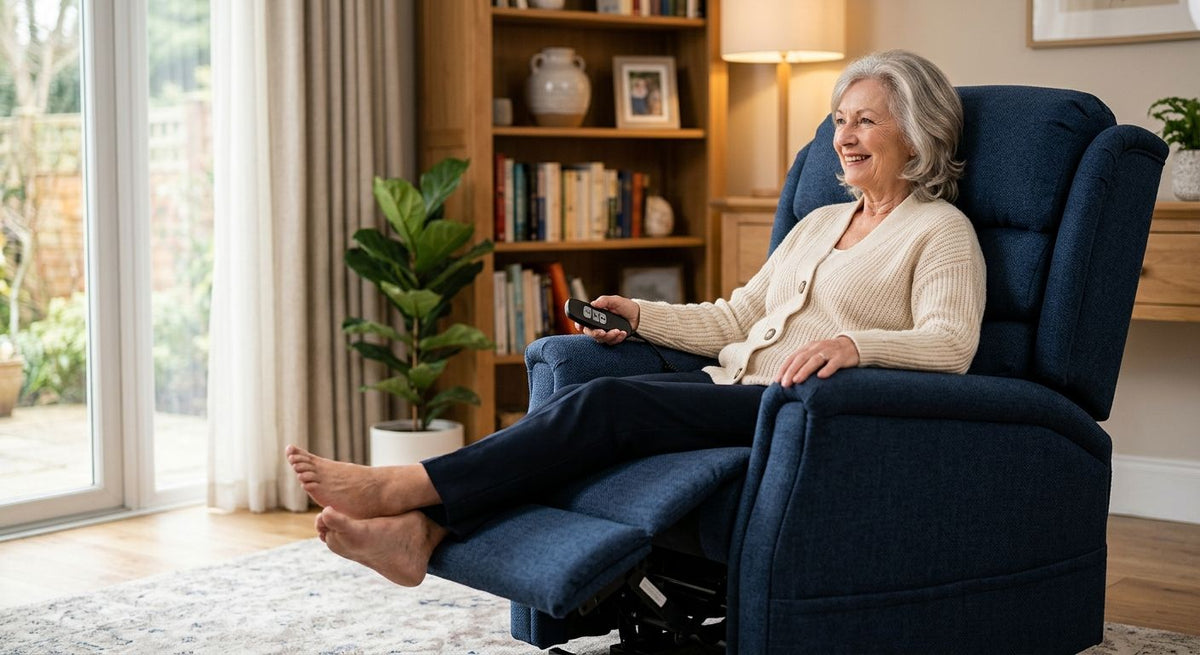
Dual motor lift chairs use two independent motors — one drives the backrest, one drives the footrest — so the chair can hold a true zero-gravity or knee-bent position that a single-motor recliner physically can't reach. This guide ranks the best dual motor lift chairs for 2026 by the use case that actually decides the purchase: caregiving, big-and-tall frames, petite bodies, medical recovery, and budget.
- Best overall dual motor lift chairs in 2026 separate backrest and footrest control instead of moving on one track.
- Best for elderly users and caregivers: a wider base, slower lift speed, and a lower step-in height.
- Best for big and tall users: reinforced frames commonly rated 500-700 lbs versus the standard 375 lbs.
- Best budget dual motor lift chair: basic zero-gravity recline without heat or massage add-ons.
- Best for medical recovery: independent knee-bend positioning for edema, sciatica, and post-surgical swelling.
Why this matters
A single-motor lift chair moves the backrest and footrest on one connected track. Recline the back and the footrest comes up automatically, locked to the same angle — fine for casual TV watching, useless for anyone who needs their knees bent while the trunk stays upright.
A dual motor lift chair breaks that connection. Aeva Vital's best power lift recliners guide covers the full 2026 market; this page narrows it to which dual motor configuration fits which body and which condition, because "best" changes completely depending on who's sitting in the chair.
The distinction matters most for anyone managing swelling, recovering from surgery, or caring for someone who can't safely reposition themselves. It matters less if you just want a comfortable recliner that also stands you up.
What makes the best dual motor lift chairs
- True independent actuation — backrest and footrest move on separate motors, not a shared cam or track
- Weight capacity matched to the user — standard frames commonly top out near 375 lbs; heavy-duty dual motor frames run 500-700 lbs
- Lift mechanism strength and angle — the seat should tilt far enough forward to get a user standing without a shove
- Battery backup — a chair stuck in a reclined position during a power outage is a real safety problem for anyone who can't self-transfer
- Upholstery suited to skin sensitivity — vinyl and antimicrobial fabrics matter more for users with limited mobility or fragile skin
- Heat and massage as a genuine feature, not a gimmick — useful for circulation and stiffness, unnecessary weight for others
At a glance
| Pick | Best for | Standout feature | Key limitation |
|---|---|---|---|
| Best overall | General home use | Independent recline + footrest with wide upholstery choice | Larger footprint, needs wall clearance |
| Best for elderly/caregivers | Assisted standing | Slower, steadier lift cycle and lower seat height | Slower lift feels sluggish to more mobile users |
| Best for big and tall | Heavier body types | Reinforced steel frame, wider seat | Bulkier profile, harder to fit small rooms |
| Best for petite/small frame | Shorter users | Shorter seat depth, lower armrests | Fewer size options on the market overall |
| Best for medical recovery | Edema, sciatica, post-surgery | Independent knee-bend without reclining the trunk | Costs more than single-motor equivalents |
| Best budget | Cost-conscious buyers | Basic zero-gravity recline | No heat, no massage, simpler upholstery |
1. Best overall dual motor lift chair: for general home use
A best-overall dual motor lift chair earns the label by handling ordinary daily use well: sitting up to eat, reclining to watch television, and standing assist without drama. It's the chair for someone who wants the flexibility of independent positioning but isn't managing a specific medical condition.
Best overall pros:
- Independent backrest and footrest control for a genuine zero-gravity position
- Widest range of upholstery and color options in the dual motor category
- Works for most body types without specialized sizing
Best overall cons:
- Dual motors add weight and mechanical complexity over single-motor chairs
- Larger frame footprint than a standard recliner
Best for: anyone replacing a worn-out recliner who wants lift assist as a bonus feature, not a medical necessity. Verdict: Buy.
2. Best dual motor lift chair for elderly users and caregivers
This category prioritizes stability over speed. A chair built for elderly users and their caregivers moves through the lift cycle more slowly and predictably, with a lower step-in height that reduces fall risk during transfers. Aeva Vital's lift chairs for elderly users guide breaks down specific models by these criteria.
Elderly/caregiver pros:
- Slower, more controlled lift cycle reduces fall risk
- Lower seat height eases transfers for users with limited leg strength
- Wider armrests give caregivers a stable grip point during assisted standing
Elderly/caregiver cons:
- Slower lift speed can frustrate more independent users
- Often heavier than standard models, harder to move once placed
Best for: households where a caregiver assists with standing. Verdict: Buy.
3. Best dual motor lift chair for big and tall users
Standard lift chair frames are commonly rated near 375 lbs. Big-and-tall dual motor models reinforce the frame and lift mechanism to commonly reach 500 to 700 lbs, with wider seats and taller backrests to match. Aeva Vital's heavy-duty lift chairs for big and tall users guide ranks specific frames by capacity.
Big and tall pros:
- Reinforced steel frame rated well above standard capacity
- Wider seat and taller backrest sized for larger frames
- Motors built to handle the added load without straining
Big and tall cons:
- Bulkier profile takes up more floor space
- Fewer upholstery colors typically offered at this capacity tier
Best for: users over the standard 375 lb capacity. Verdict: Buy.
4. Best dual motor lift chair for petite and small-frame adults
Most lift chairs are built around an average adult frame, which leaves shorter or smaller users with their feet dangling off the footrest or armrests set too high to use comfortably. A petite-frame dual motor chair shortens the seat depth and lowers the armrest height so the chair actually fits.
Petite/small-frame pros:
- Shorter seat depth prevents pressure behind the knees
- Lower armrest height improves grip during standing assist
- Independent footrest motor still gives full recline flexibility
Petite/small-frame cons:
- Fewer models exist in this size range compared to standard sizing
- Smaller frames sometimes trade off on weight capacity
Best for: users under roughly 5'4" who find standard chairs oversized. Verdict: Buy.
5. Best dual motor lift chair for medical recovery and swelling
This is the category where the dual motor design stops being a convenience and becomes the reason to buy. Independent footrest control lets the knees bend and elevate above heart level while the backrest stays upright — the position doctors recommend for edema, sciatica flare-ups, and post-surgical swelling that a single-motor recliner simply cannot produce.
Medical recovery pros:
- Only configuration that elevates legs without reclining the trunk
- Reduces the need to prop pillows under swollen legs
- Supports positions recommended after knee or hip replacement
Medical recovery cons:
- Costs more than single-motor or non-medical dual motor models
- Some insurance plans only cover the lift mechanism, not the full chair
Best for: recovery from surgery or managing chronic swelling and nerve pain. Verdict: Buy.
6. Best budget dual motor lift chair
A budget dual motor chair keeps the two-motor independent recline but strips out heat, massage, and premium upholstery. It's still a genuine dual motor chair — the mechanism that matters most is unchanged — just without the extras.
Budget pros:
- Keeps independent backrest/footrest actuation, the core feature that matters
- Simpler mechanics mean fewer parts that can fail
- Wide availability across basic vinyl and fabric options
Budget cons:
- No heat or massage functions
- Fewer size and capacity options than premium tiers
Best for: buyers who want the true dual motor mechanism without paying for add-ons. Verdict: Buy if budget is the deciding factor; Hold for a mid-tier model if heat and massage matter to you.
“If the footrest doesn't drop independently of the backrest, it's not a real dual motor lift chair.”
How this list was ranked
Each pick was matched to one criterion from the list above — frame capacity, lift speed, seat sizing, or medical positioning — rather than stacked against every other chair on every metric. That's why no two entries compete for the same "best for" slot: a big-and-tall frame and a petite-frame chair solve different problems, not the same problem better or worse.
Which dual motor lift chair should you choose?
If you're not managing a specific body-size or medical constraint, the best overall dual motor lift chair covers the widest range of daily use in 2026. If a caregiver assists with standing, prioritize the elderly/caregiver category for lift-cycle stability over speed. If a doctor has recommended leg elevation for swelling or recovery, the medical recovery category is the only configuration that actually delivers that position — don't substitute a single-motor recliner and expect the same result.
FAQ
What is a dual motor lift chair?
A dual motor lift chair uses two separate motors, one for the backrest and one for the footrest, so each moves independently instead of on one shared track. This allows positions like zero-gravity or a knee-bent recline with the trunk upright, which single-motor chairs can't reproduce.
Is a dual motor lift chair better than a single motor model?
For most daily recliner use, single motor is adequate and typically costs less. Dual motor is the better choice when independent leg elevation matters, such as for edema, post-surgical swelling, or sciatica.
How much weight can a dual motor lift chair hold?
Standard dual motor lift chairs are commonly rated near 375 lbs. Big-and-tall and bariatric frames extend that to a commonly cited 500 to 700 lbs range, depending on the frame and reinforcement.
Can dual motor lift chairs recline flat for sleeping?
Some dual motor lift chairs reach a near-flat lay-flat position, but not all do — check the specific model's recline range before assuming it works as a sleeping surface. Zero-gravity is a different position from fully flat.
Do dual motor lift chairs have battery backup?
Battery backup is available on some dual motor lift chairs and matters most for users who can't safely self-transfer without the lift function during a power outage. It's a feature to confirm before buying, not something every model includes.
What's the best dual motor lift chair for elderly users?
The best dual motor lift chairs for elderly users prioritize a slower, steadier lift cycle and a lower step-in height over speed, which reduces fall risk during standing assist. Wider armrests also give caregivers a stable grip point.
Are dual motor lift chairs covered by Medicare?
Medicare Part B can cover the seat-lift mechanism itself as durable medical equipment when a doctor documents medical necessity, typically at 80% of the approved amount after the deductible. It generally does not cover the chair's upholstery or frame cost.
How do you clean a dual motor lift chair?
Vinyl and faux leather upholstery wipes down with a damp cloth and mild soap, while fabric models usually need a fabric-safe upholstery cleaner. Check the manufacturer's care tag before using any solvent-based cleaner near the motor housing.
One last thing
Most buyers assume the recline is the point of a lift chair. It isn't — the point of dual motor construction is the knee-bend position independent of the backrest, and that single feature is the entire reason anyone managing edema or post-surgical swelling should skip single-motor chairs entirely, no matter how good the price looks.